






Metformin in 2026: New Uses Beyond Diabetes
Introduction
Over 422 million people live with diabetes worldwide, according to the WHO — but Metformin’s story is far bigger than blood sugar. Metformin is now one of the most researched medicines on the planet, with scientists uncovering remarkable new uses beyond its original role in type 2 diabetes. As a biguanide class drug, it has quietly become a candidate for fighting cancer, slowing ageing, managing polycystic ovary syndrome (PCOS), and protecting the heart. Furthermore, the interest in buying Metformin online for off-label uses has grown sharply in 2026. In this guide, we explore how Metformin works, its clinical benefits,
correct dosage, side effects, and where to order it safely online.
What Are the Emerging Uses of Metformin in 2026?
For decades, doctors prescribed Metformin only to control blood glucose in type 2 diabetes. However, a wave of new research has changed the conversation entirely. Today, researchers and physicians are studying Metformin as a treatment option for several conditions beyond diabetes. Moreover, major clinical trials now investigate its potential as an anti-ageing agent.
Key Research Statistics
- Global Diabetes Prevalence: Over 422 million adults (WHO, 2023)
- TAME Trial: Landmark NIH-backed study — 3,000 non-diabetic participants aged 65–79 testing Metformin for healthy ageing (ongoing, 2026)
- Cancer Risk Reduction: Observational studies suggest Metformin users have 30–40% lower incidence of several cancers vs non-users (PubMed, 2024)
- Longevity Study: UC San Diego (2025): Metformin use linked to a 30% lower risk of death before age 90 in postmenopausal women vs sulfonylurea
- PCOS Use: Metformin is used off-label in PCOS management worldwide, supported by international endocrinology guidelines
How Does Metformin Work? Understanding Its Mechanism
Mechanism of Action of Metformin (Biguanide)
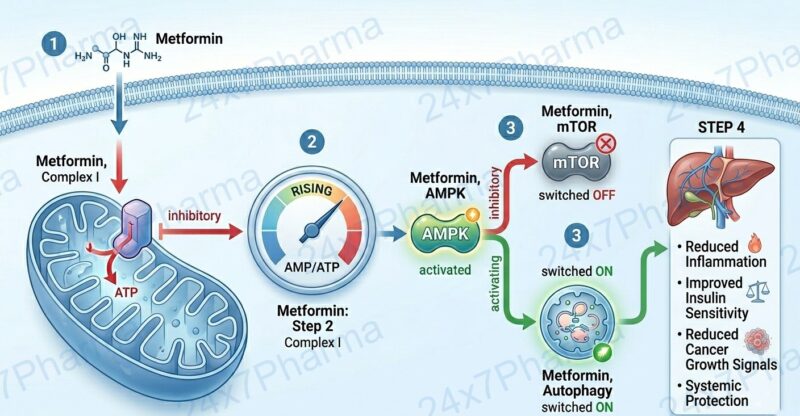
Metformin works primarily by activating an enzyme called AMPK — adenosine monophosphate-activated protein kinase. Think of AMPK as a cellular energy sensor. When it is activated, it tells the body to stop unnecessary energy-wasting processes and focus on efficiency. As a result, the liver produces less glucose, cells become more sensitive to insulin, and inflammation is reduced.
Furthermore, Metformin inhibits a step in the mitochondria — the cell’s energy factory — called Complex I of the electron transport chain. This reduces oxidative stress (harmful chemical reactions in cells). Consequently, cells age more slowly, and cancerous growth signals are suppressed.
Key New Uses of Metformin Beyond Diabetes
Why Researchers Are Excited About Metformin
Metformin’s new uses span several disease areas. Each is backed by growing clinical evidence. Below are the most promising applications in 2026:
Anti-Ageing and Longevity
The TAME (Targeting Ageing with Metformin) Trial, backed by the American Federation for Aging Research, tests whether Metformin can delay multiple age-related diseases simultaneously. Additionally, a 2025 UC San Diego study found Metformin users had a 30% lower risk of dying before age 90. Researchers believe this is linked to Metformin reducing cellular ageing (senescence) and inflammation.
Cancer Prevention and Adjunct Therapy
Multiple observational studies link regular Metformin use to a 30–40% lower incidence of colorectal, breast, and liver cancers. Furthermore, 2025 research published in MDPI’s Cancers journal shows Metformin enhances immune cell (NK cell) activity inside tumours — helping immunotherapy work better. Trials in Li Fraumeni syndrome patients are also ongoing.
Polycystic Ovary Syndrome (PCOS)
Metformin is widely used off-label for PCOS — a hormonal disorder affecting up to 10% of women worldwide. It reduces insulin resistance, lowers excess androgens (male hormones), and can restore regular ovulation. Consequently, it is recommended in international gynaecology guidelines as a first-line treatment option for PCOS.
Cardiovascular Protection
In diabetic patients, Metformin reduces the risk of heart attacks and cardiovascular death. Moreover, research suggests it may benefit non-diabetic patients with existing heart disease. Its lipid-lowering properties and anti-inflammatory effects make it a cardiovascular research priority.
Alzheimer’s Disease and Brain Health
Early-stage studies suggest Metformin may protect brain cells and reduce neuroinflammation. The drug may also lower dementia risk by improving brain insulin sensitivity. However, large-scale trials are still needed to confirm this benefit in non-diabetic populations.
Fatty Liver Disease (MASLD)
Metformin shows potential in treating metabolic dysfunction-associated steatotic liver disease (MASLD, previously known as NAFLD). It improves liver enzyme levels and reduces fat accumulation in the liver in overweight patients.
What Is Metformin? Drug Overview
Metformin (generic name: Metformin Hydrochloride) belongs to the biguanide drug class. It has been FDA-approved for type 2 diabetes since 1994 and is available in immediate-release (IR) and extended-release (XR) formulations. Moreover, Metformin is one of the most affordable medicines globally — making it accessible for long-term use.
You can order Metformin online at 24x7Pharma with discreet, worldwide delivery. Additionally, the diabetes medicines category features a full range of related treatments.
Metformin Dosage & Administration
| Parameter | Details |
|---|---|
| Standard Dose (Diabetes) | 500mg–2,000mg daily (divided doses with meals) |
| Frequency | Twice or three times daily (IR); once daily (XR) |
| PCOS / Off-label | 500mg–1,500mg daily — as directed by specialist |
| With or Without Food | Always take with food to minimise stomach upset |
| Missed Dose | Take as soon as you remember; skip if it is almost time for next dose — never double-dose |
| Dose Adjustment (Renal) | Contraindicated if eGFR < 30 mL/min/1.73m²; reduce dose if eGFR 30–45 |
| Storage | Store below 25°C, away from light and moisture |
Important: Always follow your doctor’s prescribed dosage. Do not self-adjust, especially for off-label uses.
Side Effects of Metformin
Metformin is generally well-tolerated. However, like all medicines, it can cause side effects in some patients.
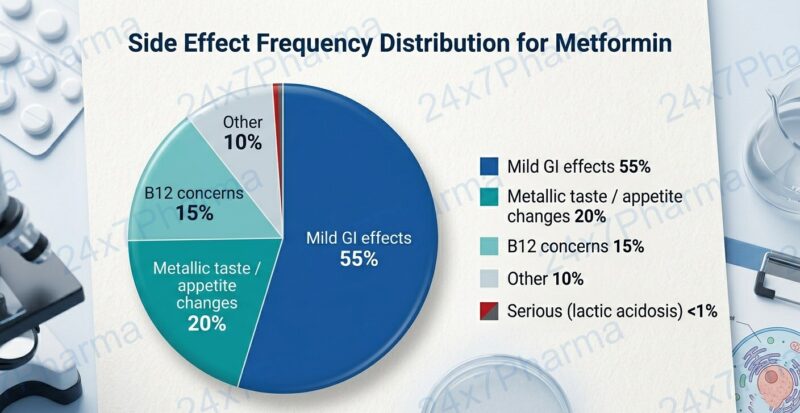
Common Side Effects (>10% of patients)
- Nausea and upset stomach — most common at the start; taking Metformin with food helps significantly
- Diarrhoea and abdominal discomfort — usually improves within the first 2–4 weeks of treatment
- Metallic taste in the mouth — a mild and temporary side effect reported by some users
- Reduced appetite — often seen as a benefit for patients managing weight alongside blood sugar
- Vitamin B12 deficiency — long-term use may reduce B12 absorption; regular blood tests are recommended
Serious Side Effects (seek immediate medical attention)
- Lactic acidosis — very rare but serious build-up of lactic acid in the blood; risk is higher in severe kidney disease
- Severe allergic reaction — rash, swelling, or breathing difficulty; stop immediately and seek emergency care
- Severe B12 deficiency — in long-term users, may cause nerve damage if untreated and unmonitored0
Who Should (and Should Not) Take Metformin?
Metformin is suitable for adults with type 2 diabetes, prediabetes, or PCOS. It is also being trialled in non-diabetic adults over 65 as part of the TAME longevity research. In addition, it may be used during certain stages of pregnancy-related diabetes, under specialist supervision.
Who Must NOT Take Metformin
- Patients with severe kidney disease (eGFR below 30 mL/min/1.73m²) — risk of lactic acidosis
- Patients with severe liver disease or acute heart failure
- Those having contrast dye procedures (CT scans) — Metformin should be paused temporarily
- Patients with known hypersensitivity to Metformin Hydrochloride
Always consult your specialist or doctor before starting Metformin — especially for any off-label use.
Patient Tips & Lifestyle Advice for Metformin Users
- Take with food: Always take Metformin with a meal to reduce nausea and stomach upset
- Stay hydrated: Drink at least 8 glasses of water daily, especially if you have kidney concerns
- Monitor blood B12 levels: Ask your doctor for an annual B12 blood test if you use Metformin long-term
- Avoid excessive alcohol: Alcohol can increase the risk of lactic acidosis when combined with Metformin
- Watch for drug interactions: Inform your doctor about all medicines, especially contrast dye agents and diuretics
- Never skip without telling your doctor: Do not stop Metformin suddenly; always discuss any changes with your healthcare provider
- Routine blood tests: Have your kidney function (eGFR) and blood glucose checked regularly as advised
- Adherence matters: Consistent daily use maximises Metformin’s long-term benefits for diabetes, PCOS, and emerging uses
Frequently Asked Questions About Metformin
Q1: Is Metformin available to buy online?
Yes. Metformin is available at 24x7Pharma with worldwide delivery to over 100 countries. Place your order securely online with full customer support.
Q2: What is the price of Metformin at 24x7Pharma?
24x7Pharma offers competitive Metformin prices compared to local pharmacies. Visit 24x7pharma to see the latest pricing and bulk order discounts. Metformin cost is kept affordable to ensure global access.
Q3: How long does Metformin take to work for blood sugar control?
For type 2 diabetes, Metformin typically begins lowering blood glucose within 1–2 weeks. However, optimal HbA1c improvements are usually measured after 3 months of consistent use. For emerging uses like PCOS, results may take 3–6 months.
Q4: Can Metformin be taken with food?
Yes — and it is strongly recommended. Taking Metformin immediately with food significantly reduces nausea and gastrointestinal side effects. Extended-release (XR) tablets should be taken with the evening meal for best results.
Q5: What should I do if I miss a dose of Metformin?
Take the missed dose as soon as you remember — unless it is almost time for your next dose. In that case, skip the missed dose and continue your normal schedule. Never take a double dose to make up for a missed one.
Q6: Are there alternatives to Metformin for diabetes or PCOS treatment?
Yes. Alternatives include SGLT-2 inhibitors (e.g., empagliflozin), GLP-1 agonists (e.g., liraglutide), and inositol supplements for PCOS. However, Metformin remains the most widely recommended and affordable first-line option. Your doctor can guide the best choice for your situation. Browse the 24x7Pharma diabetes medicines range for more options.
Conclusion
Metformin in 2026 is far more than a diabetes drug. From slowing cellular ageing and supporting cancer treatment to managing PCOS and protecting the heart, Metformin is proving to be one of the most versatile medicines in modern pharmacology. Furthermore, its affordability and decades-long safety record make it a trusted first-choice treatment worldwide.
As research from landmark trials like TAME and multiple PubMed-published studies continues to confirm Metformin’s broad potential, both patients and clinicians can feel confident in its expanding role. In addition, regulatory interest in new indications for Metformin is growing rapidly in 2026.
Disclaimer
The information in this blog is for educational purposes only and does not constitute medical advice. Always consult a qualified healthcare professional before starting, stopping, or changing any medication. 24x7Pharma does not diagnose, prescribe, or replace professional medical guidance.